Discover the fascinating world of ancient Chinese wisdom, where palm lines, facial features, birth dates, and the Five Elements offer a unique perspective on life.
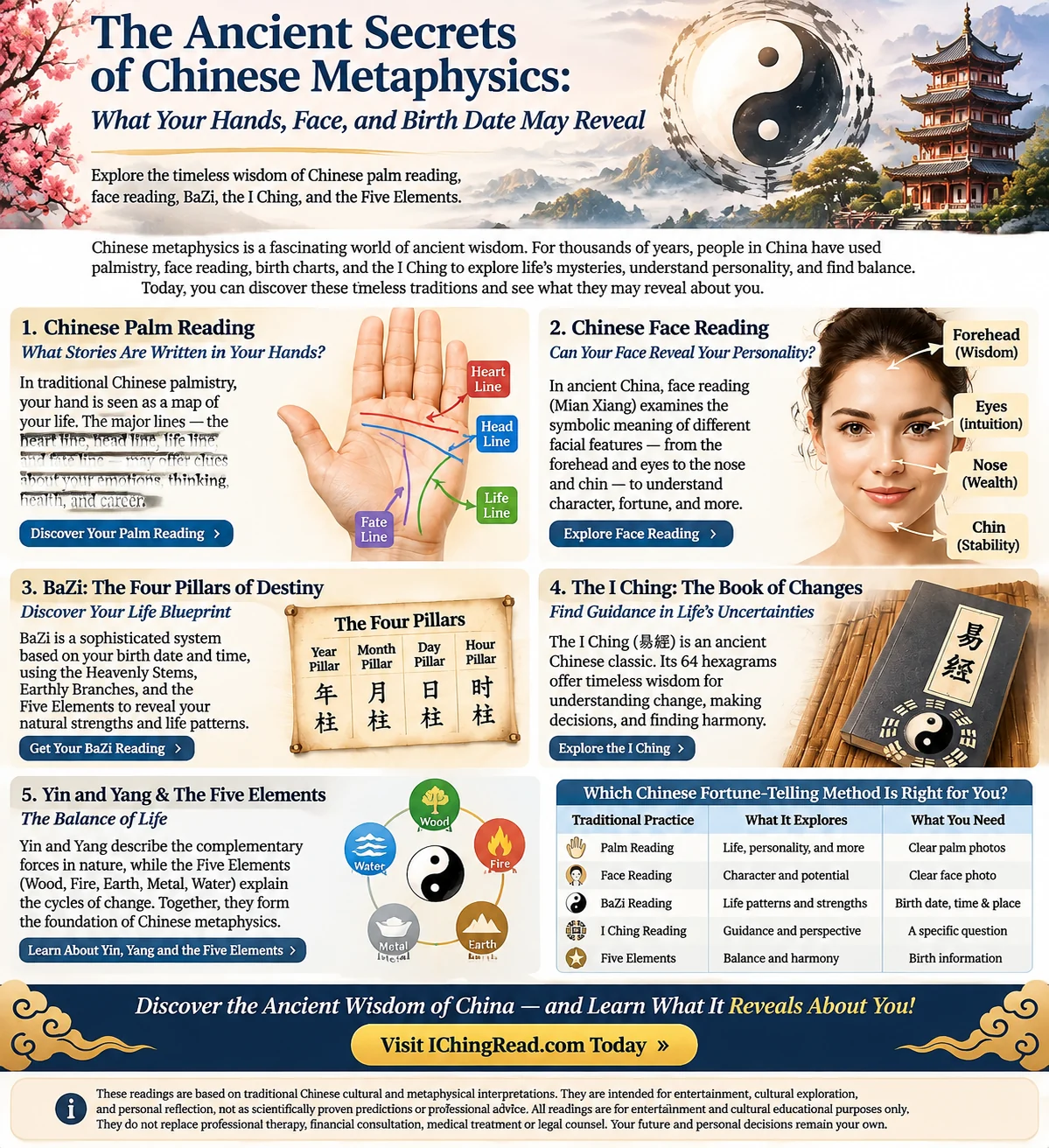
Have you ever wondered whether the lines on your hands hold a deeper meaning? Or whether your birth date could reveal something about your personality, natural strengths, and life’s journey?
For thousands of years, Chinese scholars and traditional practitioners have explored these questions through a fascinating collection of systems known today as Chinese Metaphysics.
Unlike Western astrology, which traditionally focuses on the positions of planets and stars, Chinese metaphysics draws upon several interconnected ideas: Yin and Yang, the Five Elements, the I Ching, palmistry, face reading, and the relationship between time and destiny.
These traditions offer a unique window into how ancient Chinese culture understood human nature, personality, relationships, and the changing patterns of life.
Let’s explore the secrets behind these ancient practices.
1. Chinese Palm Reading: What Stories Are Written in Your Hands?
Have you ever looked closely at the lines on your palm? In traditional Chinese palmistry, the hand is viewed as a symbolic map that practitioners interpret to explore aspects of a person’s character, experiences, and life journey.
The Heart Line
Located near the top of the palm, the Heart Line is traditionally associated with emotions, affection, and relationships.
The Head Line
The Head Line is traditionally associated with thinking, decision-making, and mental tendencies.
The Life Line
The Life Line curves around the base of the thumb. Contrary to a common misconception, traditional palm reading does not simply use this line to predict how long someone will live. It is often interpreted symbolically in relation to vitality, life experiences, and personal changes.
The Fate Line
Not everyone has a clearly defined Fate Line. In traditional palmistry, it is associated with career direction, personal ambitions, responsibilities, and external influences on one’s journey.
Can Your Palm Really Tell Your Fortune?
Palmistry is an ancient interpretive tradition, not a scientifically validated method of predicting the future. Many people nevertheless enjoy exploring what their hands may symbolize as a starting point for personal reflection.
2. Chinese Face Reading: Can Your Face Reveal Your Personality?
In ancient China, face reading was known as Mian Xiang (面相). Traditional practitioners examined the symbolic meanings associated with different facial regions, including the forehead, eyebrows, eyes, nose, mouth, and chin.
The Forehead: Wisdom and Early Life
The forehead is associated with intelligence, early experiences, learning, and opportunities during the earlier stages of life.
The Eyes: Inner Expression
The eyes have traditionally been regarded as an important feature. Their shape and expression are symbolically associated with emotional expression, awareness, and personal temperament.
The Nose: Wealth and Financial Symbolism
In classical interpretations, the nose is sometimes called the Palace of Wealth. Its shape and proportions are symbolically associated with financial tendencies and material resources.
The Chin: Later Life and Stability
The chin is traditionally associated with stability, family life, support, and the later stages of one’s life journey.
Traditional face reading is a historical cultural practice, not a scientific personality assessment. It should not be used to judge someone’s character, intelligence, morality, or abilities based on appearance.
3. BaZi: The Ancient Chinese Art of Reading Your Birth Destiny
BaZi (八字), also known as the Four Pillars of Destiny, is a sophisticated system in traditional Chinese metaphysics. It uses the date and time of your birth to construct a chart of eight characters.
The four pillars are the Year Pillar, Month Pillar, Day Pillar, and Hour Pillar. Each pillar contains two Chinese characters derived from the Heavenly Stems and Earthly Branches.
How Is a BaZi Chart Calculated?
BaZi charts are calculated using the traditional Chinese calendrical system, incorporating the Heavenly Stems, Earthly Branches, and the 24 solar terms. It is not simply a matter of converting your Gregorian birthday into a Chinese lunar calendar date. The solar terms play an important role in determining the year and month pillars.
For a more accurate traditional chart calculation, your birth date, exact birth time, and birthplace or relevant time zone are important. If your birth time is unknown, tell the reader rather than guessing.
The Five Elements: Wood, Fire, Earth, Metal, and Water
- Wood: growth, development, flexibility, and new beginnings.
- Fire: warmth, enthusiasm, expression, and transformation.
- Earth: reliability, balance, nourishment, and foundations.
- Metal: discipline, organization, precision, and strength.
- Water: adaptability, communication, flexibility, and wisdom.
In BaZi, these elements are not simply physical substances. They represent interconnected patterns of change and interaction. A traditional reading may explore symbolic themes related to personal tendencies, career interests, relationships, periods of change, and the interaction of the Five Elements.
Why Is BaZi Different from Western Astrology?
Western astrology generally uses the positions of celestial bodies at the time of birth. BaZi instead uses the traditional Chinese calendrical system, Heavenly Stems, Earthly Branches, and Five Elements. Both traditions explore the relationship between human life and patterns of time, but they use different philosophical frameworks.
4. The I Ching: The Ancient Chinese Book of Changes
The I Ching (易经), often translated as the Book of Changes, is one of the most influential classical Chinese texts. It has shaped Chinese philosophy, culture, and traditional approaches to understanding change.
The I Ching uses 64 hexagrams, each formed from six broken or unbroken lines. These hexagrams represent different patterns and situations.
Traditionally, people consulted the I Ching when facing important decisions, uncertainty, or changes in life. Rather than simply offering a yes-or-no answer, its interpretations encourage people to examine their circumstances, recognize changing conditions, and consider possible courses of action.
The I Ching is not merely a fortune-telling technique. It is also a philosophical framework for thinking about life, balance, and change.
5. Yin and Yang: The Hidden Philosophy Behind Chinese Metaphysics
To understand Chinese metaphysics, it is important to understand Yin and Yang (阴阳). This ancient philosophical concept describes two complementary forces that interact throughout nature and human life.
Yin is traditionally associated with stillness, receptivity, darkness, coolness, and reflection.
Yang is traditionally associated with movement, activity, brightness, warmth, and expansion.
Neither Yin nor Yang is inherently good or bad. They depend on one another and continually transform.
In traditional Chinese metaphysics, Yin and Yang provide a foundation for understanding the Five Elements, BaZi, and other systems. These traditions explore patterns, relationships, balance, and change.
6. Which Chinese Metaphysical Reading Is Right for You?
Each traditional Chinese system explores a different aspect of human experience. This guide can help you choose a starting point.
| Traditional Practice | What It Explores | What You Need |
|---|---|---|
| Palm Reading | Symbolic interpretations of palm lines and hand features | Clear palm photos |
| Face Reading | Traditional symbolism associated with facial features | Clear face photo |
| BaZi Reading | Birth chart, Five Elements, and life patterns | Birth date, time, and birthplace |
| I Ching Reading | Life situations, changes, and personal reflection | A specific question |
| Five Elements Analysis | Symbolic balance and interaction of the Five Elements | Birth information, depending on the analysis |
You do not need to understand Chinese philosophy before exploring these practices. IChingRead.com introduces traditional concepts to an international audience through personalized digital readings.
7. Discover What Ancient Chinese Wisdom May Reveal About You
For thousands of years, Chinese traditions have explored the connections between people, nature, time, and change. Today, you can explore these traditions without having to travel to China or study ancient Chinese texts.
Personal Palm Reading
Discover traditional interpretations of your palm lines and hand features.
Chinese Face Reading
Explore the traditional symbolism associated with facial features.
BaZi Four Pillars Reading
Use your birth information to explore the Five Elements and your traditional Chinese birth chart.
I Ching Reading
Explore an ancient Chinese approach to uncertainty, decisions, and life’s changing circumstances.
Your Journey into Ancient Chinese Wisdom Starts Here
Explore your hands, face, birth chart, and the wisdom of the I Ching.